bar_chart 統計資訊
sports_esports
- 總局數
emoji_events
-
總勝場
diamond
-
總得分
統計數據

遊戲

遊戲局數-
勝率-
完美獲勝-
總分數-

時間

最佳時間-
平均時長-

你確定要重置統計嗎?

編輯資料

<< 返回列表

X-Wing Technique in Sudoku

The X-Wing Technique

The X-Wing pattern can occur in rows or in columns.

X-Wing Pattern in Rows

In Sudoku, when a certain number may only be placed in two positions in each of two rows, and those positions are in two columns, then a number is placed in those two rows, an X-Wing is formed. The number must then go in one of those two cells in each row, thereby "locking" it in those two columns in both rows. Hence, that number can be eliminated in candidates of other cells in those two columns.

Example 1

Sudoku rule X-Wing

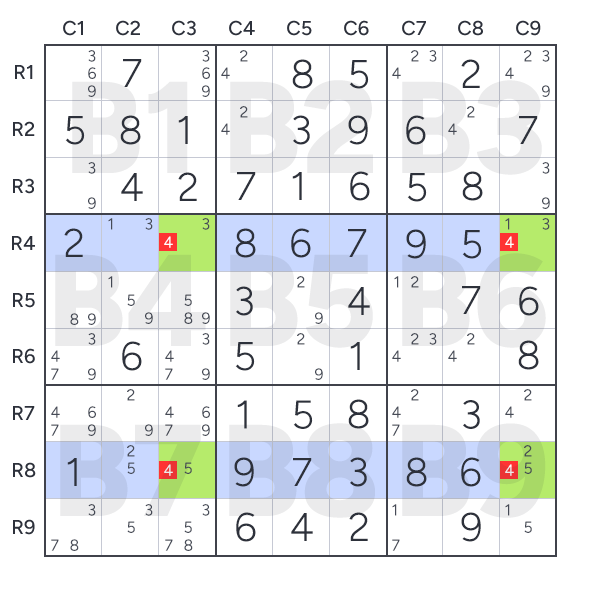
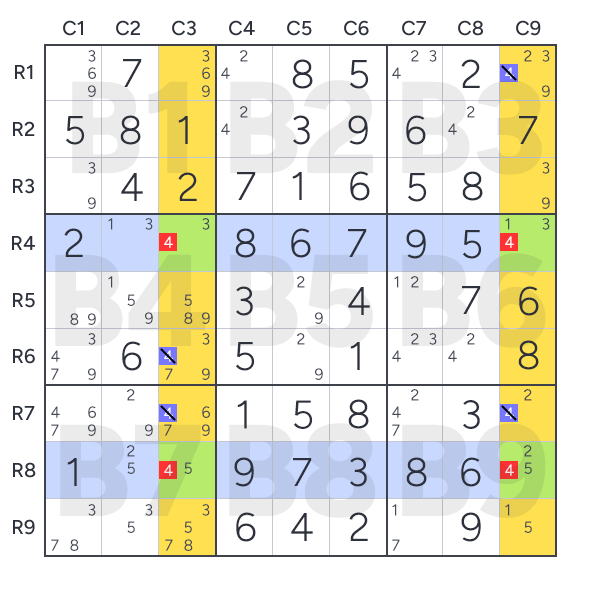
Consider rows R4 and R8. The number 4 is only possible in two cells in each of these rows, and that is, in columns C3 and C9. These four cells are what is known as the X-Wing pattern. The number 4 can be positioned in only two ways.

Sudoku rule X-Wing

  1. At (R4,C3) and (R8,C9)
  2. At (R8,C3) and (R4,C9)

In both cases, there will be one count of the number 4 in both columns C3 and C9. Hence, it can be said that 4 can be eliminated in all other cells in those two columns.

X-Wing in Columns

The same tactic can be applied to columns. In this case, just switch rows for columns and the other way around. An example of the x-wings technique in this case might be vertically oriented.

Example 2

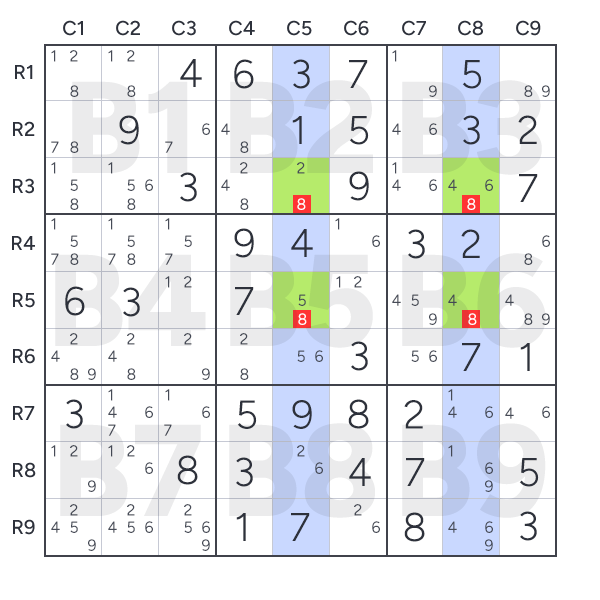
Sudoku rule X-Wing Let us examine columns C5 and C8. In each, the number 8 is only a candidate in two cells, and the cells of interest are in the same two rows, namely R3 and R5. In the case, these four cells form an x-wing configuration in the columns.

Sudoku rule X-Wing

Take for example the two positions of number 8. In each case, there are two ways to validly place the number 8, resulting in the following options:

  • (R3,C5) and (R5,C8)
  • (R5,C5) and (R3,C8)

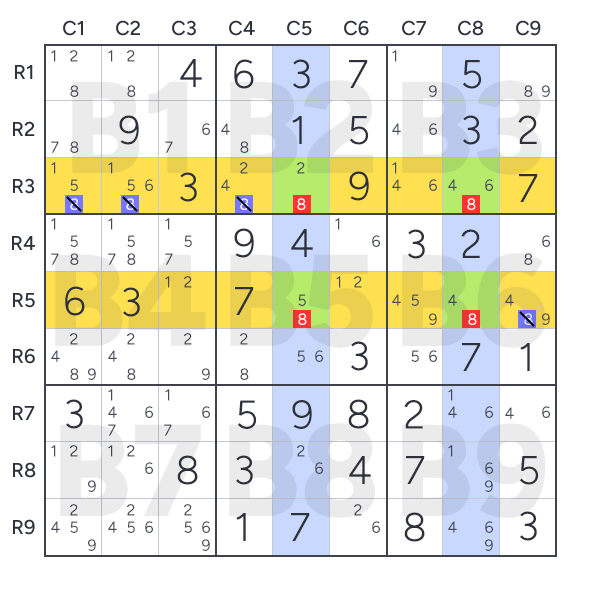
In both ways, rows R3 and R5 each will have together two 8s. This implies that 8 will no longer be a candidate in any of the cells in those two rows. The rest of the candidate positions, that have 8 in rows R3 and R5 (shown in orange for example) can be crossed out as they are incorrect.

Once you're comfortable with the X-Wing pattern, the next step is to explore XY-Wing, which relies on candidate logic rather than strict row-column symmetry. After mastering the X-Wing, you can move on to techniques like XY-Wing, which will help you sharpen your logical solving skills.

Loading...