XY-Wing Technique in Sudoku
The XY-Wing in Sudoku
The XY-Wing is a unique, simplified type of an Xy-Chain "pattern" which is often recognized separately, thereby streamlining the identification process during the actual solving of puzzles.
It starts with finding a candidate bivalue cell, termed as a pivot, which harbors only two candidates known as X and Y. Then, we look for two other cells that both contain a unit (row, column or block) with the pivot. These are known as pincers.
One pincer has to contain candidates X and Z, and the other Y and Z, with Z being a candidate other than X and Y. In cases where both pincers can 'see' a cell, the candidate Z can be eliminated from that cell.
Example 1
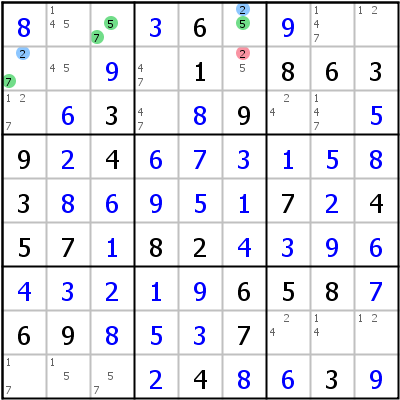
Let's take the pivot at r1c3 with the candidates being 5 (X) and 7 (Y).
- In r1c6 (which is in Row 1), 5 (X) and 2 (Z) are present.
- In r2c1 (which is in Block 1), 7 (Y) and 2 (Z) are present.
Pincer r2c6 is seen by both pincers r1c6 and r2c1, meaning it cannot have candidate 2 (Z).

Why is that the case?
If the pivot is 5, r1c6 must be 2. If it's 7, then r2c1 must be 2. In both cases, one pincer will be 2, meaning r2c6 cannot be 2.
Example 2
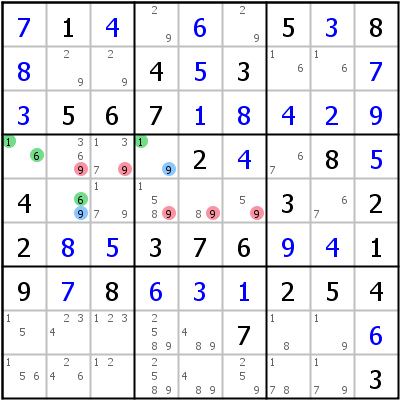
Let's take X = 1, Y = 6, Z = 9.
- The pivot is at r4c1.
- The pincers are at r4c4 and r5c2.
Any cell that can 'see' both pincers cannot have candidate 9 (Z). In this case, five candidate 9s can be eliminated.

The XY-Wing provides a foundation for more advanced techniques, such as the W-Wing, which connects two bi-value cells through strong links. Once you've grasped the XY-Wing, the next step is the W-Wing, an advanced strong-link variation that broadens your Sudoku strategy.