
The Unique Rectangle Technique in Sudoku
What Is a Unique Rectangle?
Unique Rectangle is a uniqueness technique. It relies on the standard Sudoku assumption that the puzzle has one solution. Four cells form the corners of a rectangle using two rows and two columns, with the corners lying in two blocks. If all four cells contain the same two candidates, the puzzle could be completed in two different ways by swapping those candidates around the rectangle.
That two-solution pattern is called a deadly pattern. A valid uniquely solvable Sudoku must contain an additional candidate or restriction that prevents the rectangle. Unique Rectangle techniques use that extra information to make a safe elimination.
The Basic Type 1 Pattern
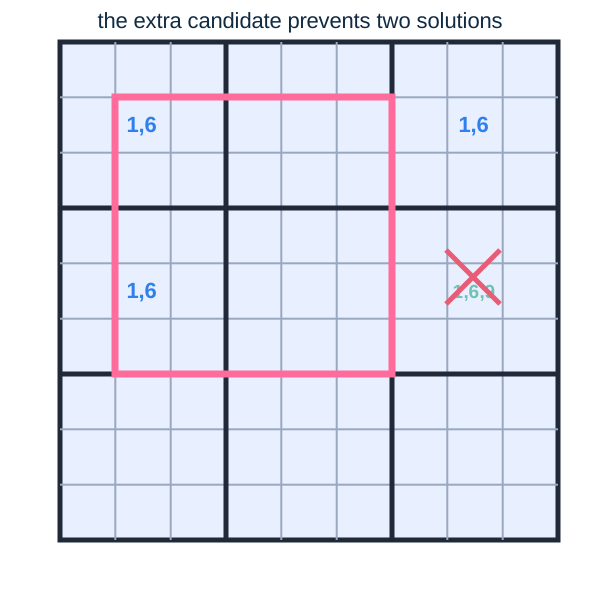
In the simplest form, three rectangle corners contain only candidates 1 and 6, while the fourth corner contains 1, 6, and an additional candidate such as 9. If 9 were removed from the fourth corner, all four cells would contain the same pair and the puzzle could have two solutions.
Therefore, candidate 9 must remain in the fourth corner, and the two-candidate corners cannot be treated as an ordinary naked pair without checking the uniqueness condition. In other Unique Rectangle types, the extra candidates or shared units change the exact elimination, so verify the pattern before removing anything.
How to Check a Unique Rectangle
- Find four cells at the corners of a two-row by two-column rectangle.
- Confirm that the corners occupy two corresponding blocks.
- Identify the two common candidates shared by the rectangle.
- Check which corner or corners contain extra candidates.
- Apply only the elimination justified by that specific Unique Rectangle type.
The rectangle must be a valid pattern of cells, not just four cells that look roughly aligned. Rows, columns, blocks, and candidate sets all matter. If the puzzle is allowed to have multiple solutions, uniqueness-based eliminations are not valid.
Why Uniqueness Matters
The technique does not claim that one of the two common candidates must go in a particular corner simply because the cells form a rectangle. The logic comes from excluding a second solution. This is why Unique Rectangle is different from Naked Pair, X-Wing, and other patterns that do not rely on a uniqueness assumption.
Common Mistakes With Unique Rectangle
- Do not use a rectangle unless the four cells occupy the required rows, columns, and blocks.
- Do not assume every rectangle gives the same elimination; the candidate configuration determines the type.
- Do not apply uniqueness logic to a puzzle that may intentionally have multiple solutions.
- Preserve the extra candidate or restriction that prevents the deadly pattern unless a specific rule proves it can be removed.
When Should I Study Unique Rectangle?
Unique Rectangle is best studied after you are comfortable with candidate notes, subsets, and basic fish patterns. It is especially useful on difficult grids where ordinary eliminations have stalled. Read the pattern as a proof about possible solutions, not as a visual shortcut.
What Should I Study Next?
Compare Unique Rectangle with XYZ-Wing to see how different candidate structures create eliminations. For more advanced uniqueness patterns, the next topics can include BUG+1 and other rectangle variations once the basic deadly pattern is clear.