
The Simple Coloring Technique in Sudoku
What Is Simple Coloring?
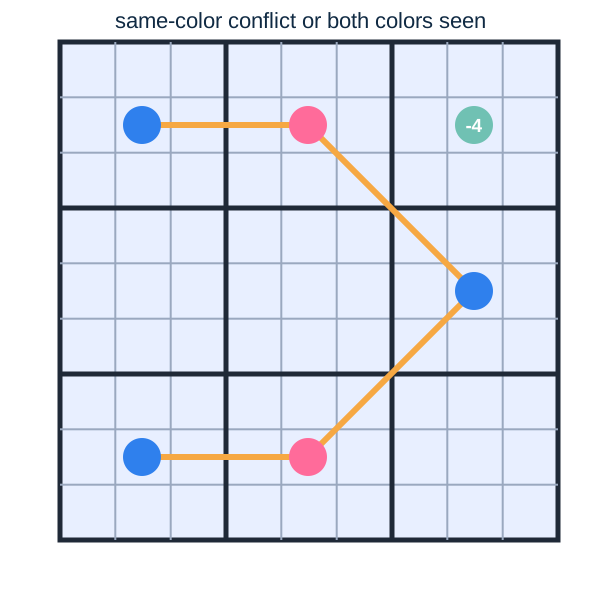
Simple Coloring is a single-candidate technique based on strong links. Choose one digit and connect pairs of its candidates that form strong links in a row, column, or block. Mark the linked candidates with two alternating colors. The colors represent the two possible ways the candidate can be placed through that chain.
The coloring produces two useful conclusions. If two candidates of the same color see each other, that color is impossible and every candidate with the opposite color is true within the chain. If an uncolored candidate can see candidates of both colors, it can be eliminated because one color must be true.
How to Build a Simple Coloring Chain
- Choose a candidate digit with several strong links.
- Start with a pair of candidates that are the only two positions for that digit in a unit.
- Give one candidate color A and the other color B.
- Continue through strong links, alternating colors each time.
- Look for a same-color conflict or an uncolored candidate that sees both colors.
Color only one candidate digit at a time. A strong link may come from a row, column, or block. Weak visibility between candidates is used to test the colored conclusions, but it does not create the alternating color chain by itself.
The Two Main Coloring Rules
Same-Color Conflict
If two candidates with the same color can see each other, they cannot both be true. That color is therefore false throughout the connected coloring chain, and candidates with the opposite color are confirmed for that chain. Remove the false color from the affected cells.
Seeing Both Colors
If an uncolored candidate can see at least one candidate of each color, it cannot be true. Whichever color is ultimately correct, one of the colored candidates would conflict with the uncolored candidate. Remove the chosen digit from that uncolored cell.
Why Simple Coloring Works
Every strong link says that at least one of its two candidates must be true. Alternating colors records the two possible states as the chain extends. A same-color conflict would require both endpoints of one strong-link state to be true, so that state is impossible. A cell seeing both colors conflicts with whichever state survives, making its candidate impossible.
Common Mistakes With Simple Coloring
- Color only one digit; different digits cannot share the same color chain.
- Alternate colors across strong links, not across every visible pair.
- Do not treat a weak link as proof that the opposite color is true.
- A same-color conflict must be based on actual visibility in a common row, column, or block.
Simple Coloring and Advanced Chains
Simple Coloring is easier to audit than a long inference chain because the two possible states are shown visually. It is a useful bridge from Skyscraper and W-Wing toward more general chain methods. Keep the candidate list accurate and stop coloring when the chain no longer follows a strong link.
When Should I Use Simple Coloring?
Try Simple Coloring after singles, subsets, and intersection eliminations have been applied. It is most effective when one candidate appears in several units with clear strong links. If no valid chain is available, switch to another candidate or return to a simpler pattern rather than forcing a color assignment.