
The Jellyfish Technique in Sudoku
What Is Jellyfish?
Jellyfish is a four-by-four fish pattern. For one candidate digit, all its positions in four base rows must be contained within the same four cover columns. The digit must occupy those four columns once each, so it can be removed from other cells in the cover columns. The column-based form exchanges rows and columns.
How to Find Jellyfish
- Choose one candidate digit.
- Find four rows where all its candidates fall within the same four columns.
- Confirm that every base row contains between two and four positions for the digit.
- Remove the digit from the four cover columns outside the base rows.
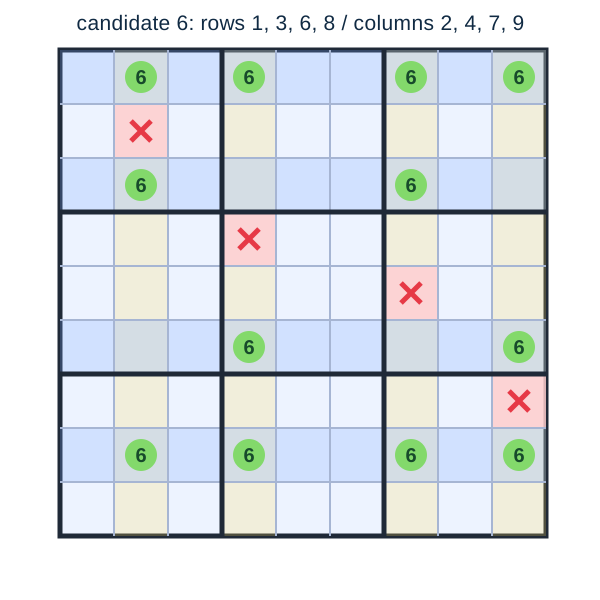
In the diagram, candidate 6 is restricted to rows 1, 3, 6, and 8 and columns 2, 4, 7, and 9. The four base rows must place four 6s in the four cover columns, so other 6s in those columns can be eliminated.
Why Jellyfish Works
Each base row needs one occurrence of the candidate, while each cover column can contain it only once. Four placements must therefore occupy all four cover columns. The exact arrangement is unknown, but no additional copy of the digit can remain in those columns.
Jellyfish and Smaller Fish
X-Wing uses two base and cover units, while Swordfish uses three. Jellyfish uses four and is correspondingly rarer and harder to spot. Extra positions outside the four cover units invalidate a standard Jellyfish.
What Are Common Jellyfish Mistakes?
Do not combine different digits, and do not eliminate candidates from the base rows themselves. The candidate positions must be fully contained in four cover units; a loose four-row pattern is not enough.
A Practical Search Workflow
Finish easier eliminations first, then filter one digit at a time. Record rows containing two to four positions and compare groups of four. Their combined candidates may be distributed differently in each row, but must use no fifth column. Repeat the scan by columns after checking all rows.
Frequently Asked Questions
Must Jellyfish contain all sixteen intersections?
No. The pattern may be sparse. Containment within four cover units is what matters.
Does every Jellyfish produce an elimination?
No. If no candidate remains in the cover units outside the base units, the pattern is valid but makes no immediate progress.
Summary
Remember one digit, four base units, and four cover units. Verify complete containment before deleting only from the cover units outside the base set.