
数独中的 W-Wing 技巧
W-Wing(W翼)是一种实用的进阶数独技巧。
它由两个候选数组合相同的双值格,以及连接它们的一个强链接组成。
当强链接成立时,可以证明两个双值格中至少有一个必须填入另一个共同候选数。因此,任何同时能看到这两个双值格的其他格子,都不能再包含该候选数。
W-Wing本质上是一条候选数推理链,但它的几何结构相对清晰,特别适合在候选数筛选模式下查找。
什么是 W-Wing?
假设两个双值格都只包含候选数X和Y。
这两个双值格本身不一定互相可见,但它们分别通过候选数Y连接到某个强链接的两个端点。强链接表示候选数Y在同一行、同一列或同一个九宫格中只剩两个可能位置,因此这两个位置中至少有一个必须填入Y。
- 如果强链接的第一端填入Y,第一个双值格就不能再填Y,因此必须填X。
- 如果强链接的第二端填入Y,第二个双值格就不能再填Y,因此必须填X。
无论哪一种情况,两个双值格中至少有一个一定填入X。因此,任何同时能够看到这两个双值格的其他格子都不能再填X,可以删除候选数X。
判断W-Wing时需要注意:
- 两个关键格都必须是双值格。
- 两个双值格拥有相同的候选数组合。
- 强链接必须使用这两个格子共同拥有的其中一个候选数。
- 最终删除的是另一个共同候选数。
- 只有同时能看到两个双值格的其他格子才能进行删除。
示例一:候选数5和9构成的 W-Wing
两个双值格r4c4和r8c9都只包含候选数5和9。
它们通过第8列中的候选数9强链接相连。在第8列中,候选数9只剩两个可能位置:
- r4c8
- r8c8
因此,这两个位置中至少有一个必须填入9。强链接端点r4c8能看到双值格r4c4,另一个端点r8c8能看到双值格r8c9。
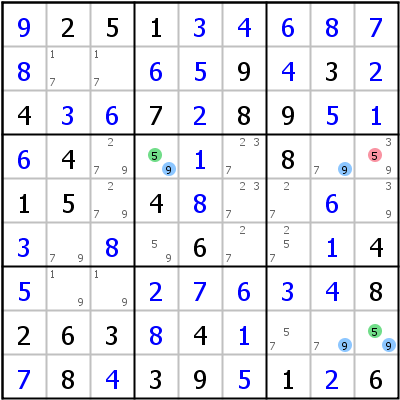
绿色标记表示两个双值格中的候选数5,蓝色标记表示候选数9及其强链接,红色标记表示r4c9中可以删除的候选数5。
示例一说明
- 如果r4c8填入9,那么r4c4不能再填9,所以r4c4必须填5。
- 如果r8c8填入9,那么r8c9不能再填9,所以r8c9必须填5。
无论哪一种情况,r4c4和r8c9中至少有一个一定填入5。
r4c9既能看到r4c4,也能看到r8c9,因此r4c9不能再填5,可以删除其中的候选数5。
示例二:候选数4和1构成的 W-Wing
双值格r1c9和r8c7都只包含候选数4和1。
它们通过第3列中的候选数1强链接相连,强链接的两个端点是:
- r1c3
- r8c3
由于第3列中的候选数1只能出现在这两个位置,因此至少有一个必须填入1。强链接端点r1c3能看到双值格r1c9,另一个端点r8c3能看到双值格r8c7。
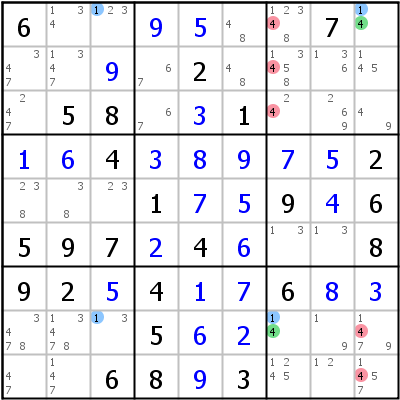
绿色标记表示两个双值格中的候选数4,蓝色标记表示候选数1及其强链接,红色标记表示可以删除的候选数4。
示例二说明
- 如果r1c3填入1,那么r1c9不能再填1,因此r1c9必须填4。
- 如果r8c3填入1,那么r8c7不能再填1,因此r8c7必须填4。
所以r1c9和r8c7中至少有一个一定填入4。
因此,可以从所有同时能看到这两个双值格的格子中删除候选数4:
- r1c7
- r2c7
- r3c7
- r8c9
- r9c9
如何寻找 W-Wing
寻找W-Wing时,可以按照以下步骤检查:
- 找出棋盘中所有双值格。
- 寻找两个拥有相同候选数组合的双值格,例如都为{4,9}。
- 确认这两个双值格通常互相不可见。
- 选择其中一个候选数,例如9。
- 检查是否存在一个关于候选数9的强链接,而且强链接的两个端点分别能看到两个双值格。
- 如果成立,另一个共同候选数4至少会出现在两个双值格中的一个。
- 从所有同时能看到两个双值格的其他格子中删除候选数4。
为了减少混乱,可以先按双值格组合筛选,例如先查找所有{4,9}双值格,再检查是否存在合适的强链接。
为什么 W-Wing 成立
W-Wing成立的关键在于强链接。
强链接表示某个候选数在同一行、同一列或同一个九宫格中只剩两个位置,因此这两个位置中至少有一个必须成立。
当强链接的两个端点分别连接到两个候选数组合相同的双值格时,无论强链接的哪一端成立,都会迫使其中一个双值格填入另一个候选数。
因此,两个双值格中至少有一个一定包含目标排除数字。任何同时能看到两个双值格的其他格子都不能再包含该数字。
常见误区
误区一:两个相同的双值格就一定构成W-Wing
不一定。还必须存在一个关于其中一个共同候选数的强链接,而且强链接两端需要分别连接两个双值格。
误区二:两个双值格必须互相可见
通常不需要。事实上,W-Wing中的两个双值格经常互相不可见。
误区三:强链接可以使用任意候选数
不可以。强链接必须使用两个双值格共同拥有的其中一个候选数。
误区四:可以从所有相关格子中删除候选数
不可以。只有同时能看到两个双值格的其他格子,才能删除另一个共同候选数。
误区五:两个双值格都会填入被保留的候选数
不一定。正确结论是两个双值格中至少有一个会填入该候选数,而不是两个格子都会填入。
误区六:W-Wing和XY-Wing是同一种技巧
不是。W-Wing通常使用两个候选数组合相同的双值格,并通过强链接建立关系;XY-Wing使用3个双值格,候选数组合为XY、XZ和YZ。
W-Wing与相似技巧的区别
W-Wing与XY-Wing
- W-Wing使用两个候选数组合相同的双值格。
- XY-Wing使用3个双值格。
- W-Wing依赖一个外部强链接。
- XY-Wing依赖轴心格与两个翼格之间的候选数关系。
W-Wing与X-Wing
- W-Wing属于候选数链和双值格逻辑。
- X-Wing是单一候选数在两行两列中的矩形结构。
- 两者名称相似,但逻辑结构完全不同。
W-Wing与XY-Chain
- W-Wing可以看作一种较短、结构固定的链式推理。
- XY-Chain通常包含更多双值格和更长的候选数链。
W-Wing与XY-Wing都依赖候选数之间的逻辑关系,而X-Wing则是一种经典的矩形模式技巧。
常见问题
什么是数独中的W-Wing?
W-Wing由两个候选数组合相同的双值格和一个强链接组成。强链接使用其中一个共同候选数,并证明两个双值格中至少有一个必须填入另一个共同候选数。
W-Wing的两个双值格必须互相可见吗?
通常不需要。关键是强链接的两个端点分别能看到两个双值格,而排除位置必须同时能看到这两个双值格。
W-Wing和XY-Wing有什么区别?
W-Wing使用两个候选数组合相同的双值格,并依赖一个外部强链接;XY-Wing通常使用3个双值格,组成XY、XZ和YZ的候选数结构。
相关技巧
学习W-Wing前,可以先回顾XY-Wing,比较两种技巧对双值格的不同用法。也可以学习X-Wing,了解单一候选数形成的矩形排除结构。
总结
识别W-Wing时,可以记住以下结构:
- 两个双值格拥有相同的候选数组合。
- 它们通过其中一个候选数的强链接相连。
- 无论强链接哪一端成立,两个双值格中至少有一个必须填入另一个共同候选数。
- 因此,可以从同时看到两个双值格的其他格子中删除该候选数。
W-Wing是理解候选数链和更复杂翼形技巧的重要基础。