
The Locked Candidates Technique in Sudoku
Core Concept
The Locked Candidates are also referred to as an Intersection Removal. This occurs when a digit can only have a certain placement within a
row/column in a certain block; this allows for eliminations in intersecting areas. This technique has two subtypes: Claiming (Type 2) and Pointing (Type 1).
Locked Candidates Type 1: Pointing (Block-to-Line)
A digit being placed within a block limits it to one row or column. Hence, it also blocks a possibility within that same line outside the block.
Example 1
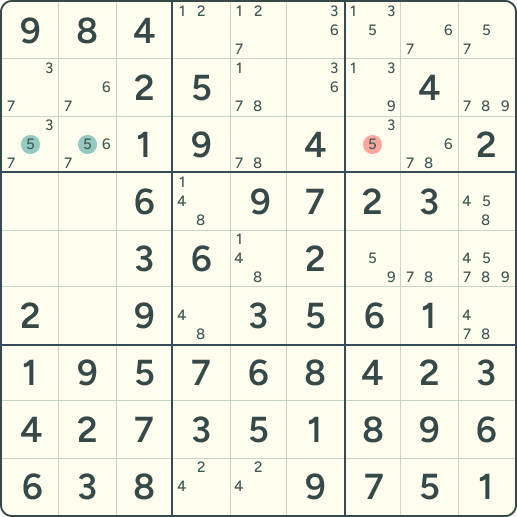
In block 1 (B1), the only positions for 5 are R3C1 and R3C2. Both are in row 3, so one of them must contain 5. Remove candidate 5 from R3C7, which is in the same row but outside B1.
Example 2
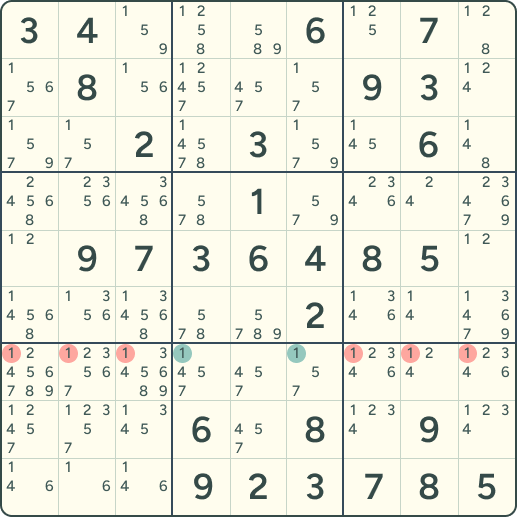
In block 8 (B8), candidate 1 is restricted to row 7. The 1 in that block must therefore be in R7C4 or R7C6. Remove candidate 1 from the six cells in row 7 outside B8, while keeping those two possible positions.
Locked Candidates Type 2: Claiming (Line-to-Block)
Once a digit's candidates are contained within one block, along a row or column, it will be excluded from other cells in that block.
Example 1 :
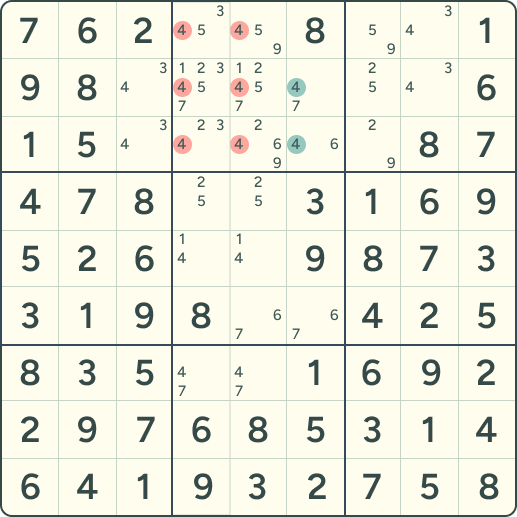
In column 6 (C6), candidate 4 appears only at R2C6 and R3C6, both inside block 2 (B2). One of these cells must contain 4, so remove candidate 4 from the other cells in B2: R1C4, R1C5, R2C4, R2C5, R3C4 and R3C5.
Example 2 :
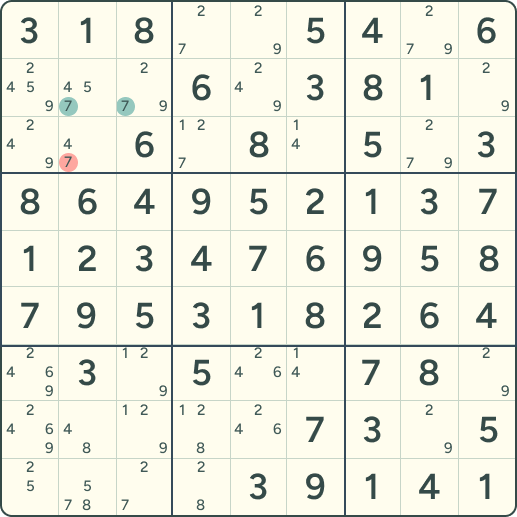
In row 2 (R2), the only positions for 7 are R2C2 and R2C3, both inside block 1 (B1). The 7 in B1 must lie in row 2, so remove candidate 7 from R3C2. Keep the candidates at R2C2 and R2C3: they establish the restriction.
This example illustrates the core idea of candidate restriction. To see it in practice, visit the Locked Pair and Locked Tripletechnique guides.